publications
a list of all my publications
2026
-
 Inferring drivers of tropical isoprene: competing effects of emissions and chemistryJames Young Suk Yoon, Kelley C. Wells, Dylan B. Millet, and 5 more authorsAtmospheric Chemistry and Physics, Apr 2026
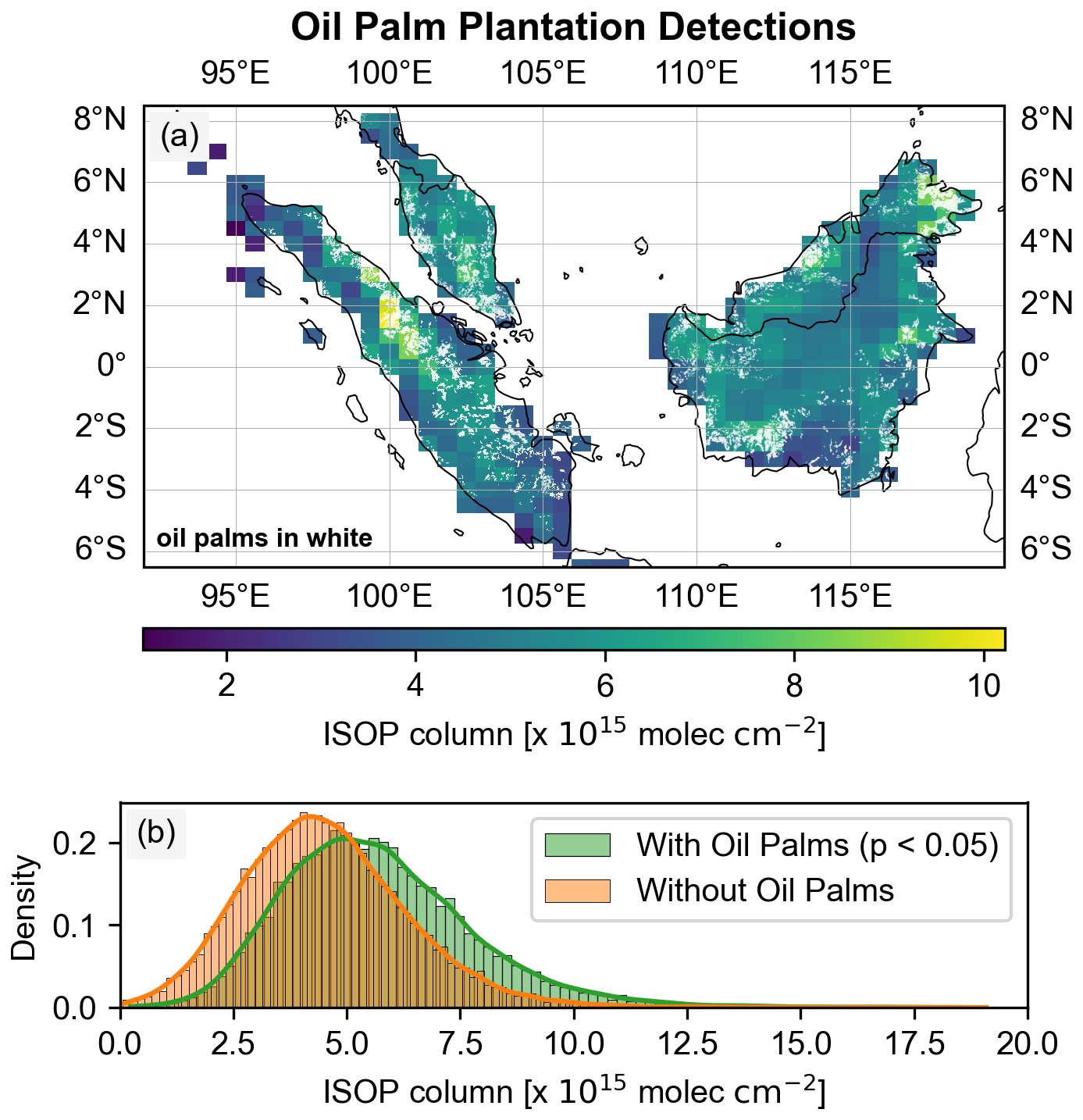
Isoprene is the most significant non-methane hydrocarbon by total emissions and an important control on the tropospheric oxidative capacity. In the atmosphere, isoprene is oxidized by the hydroxyl radical (OH) on the order of hours depending on local OH concentrations. Using isoprene retrievals from the Cross-track infrared sounder (CrIS), we monitor global isoprene column variability and observe differing isoprene column responses to El Niño-Southern Oscillation across three tropical regions: Amazonia, the Maritime Continent, and equatorial Africa. We find correlations between isoprene column variability and temperature over Amazonia, which suggests that isoprene emissions drive Amazonian isoprene variability (“emissions-controlled”). In the Maritime Continent, we find strong correlations between isoprene columns, precipitation and soil moisture, as well as an anti-correlation between isoprene and formaldehyde retrievals. These correlations suggest that isoprene columns may be modulated by non-anthropogenic NOx emissions, namely soil and biomass burning NOx (“chemistry-controlled”), although convection and lightning NOx may also modulate isoprene column retrievals if the lofted isoprene flux is large enough. In equatorial Africa, both biomass burning and temperature can explain isoprene variability during different periods, representing an intermediate regime with contributions from emissions and chemistry. We suggest that these isoprene regimes are caused by differences in the dynamic temperature and oxidant range between the three regions, and we specifically highlight oil palm plantations in the Maritime Continent as an area of co-located isoprene and soil NOx fluxes. By leveraging CrIS isoprene retrievals, we can study interactions between VOC and NOx sources over tropical areas with few in-situ observations.
2025
-
 Impacts of Interannual Isoprene Variations on Methane Lifetimes and TrendsJames (Young Suk) Yoon, Kelley C. Wells, Dylan B. Millet, and 3 more authorsGeophysical Research Letters, 2025
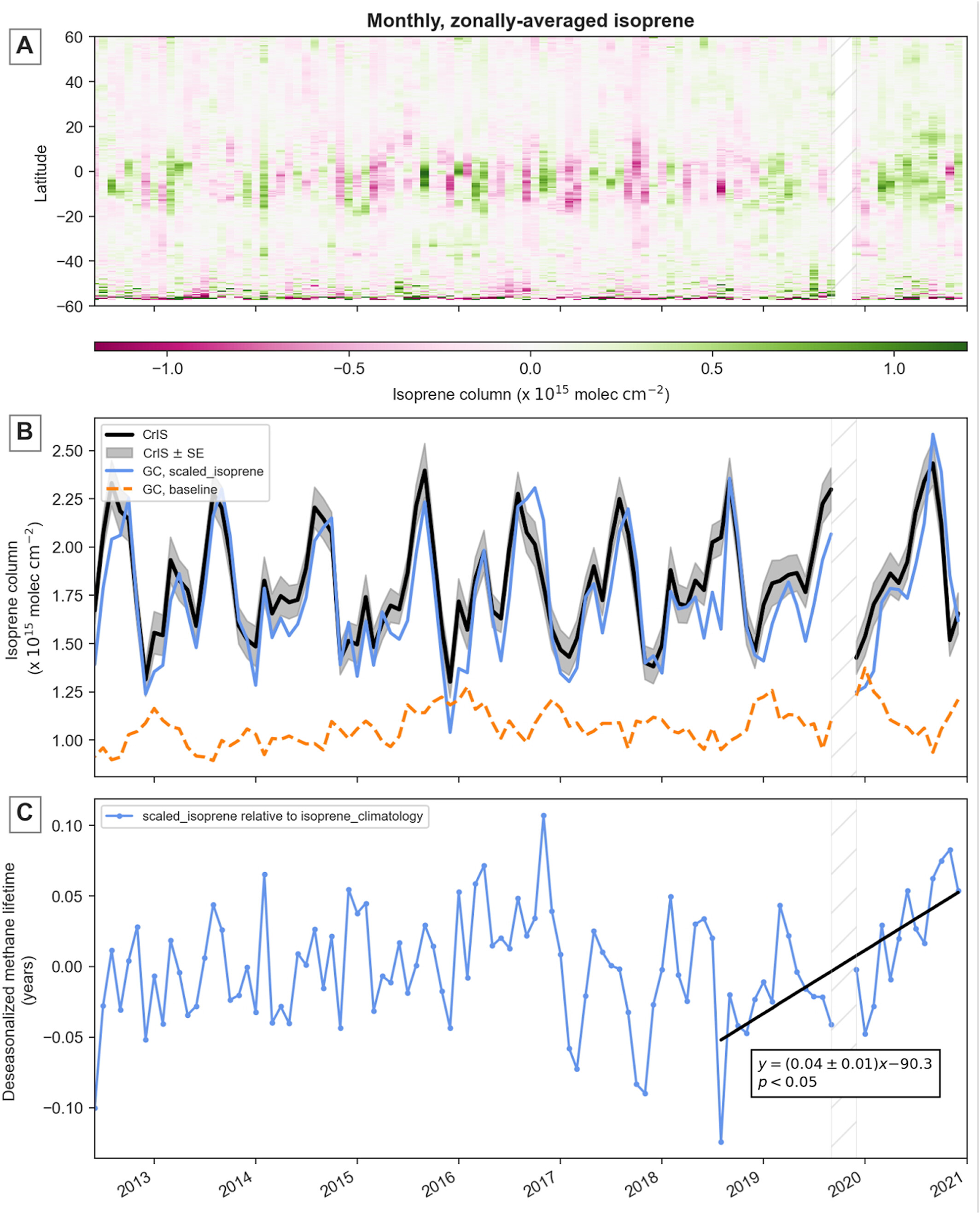
Recent observations show anomalously high methane growth in 2020, which has been attributed to increased wetland emissions and decreased OH from lower COVID-19 nitrogen oxide (NOx) emissions. NOx is not the only species that affects OH—isoprene, the most significant non-methane hydrocarbon by total emissions, is oxidized by OH, which can deplete OH during periods of high emissions. Using satellite isoprene retrievals from the Cross-track infrared sounder (CrIS), we find anomalously high isoprene columns during 2020, coincident with high methane growth. Isoprene’s oxidation produces carbon monoxide, which can be transported over longer distances and decrease OH outside of isoprene source regions. Elevated isoprene concentrations may have contributed 13% (bounds: 10%–28%) of 2020’s methane growth if we assume no change in NOx emissions in 2020. Since COVID-19 decreased anthropogenic NOx emissions, this estimate is an upper-limit and may depend on whether isoprene or NO emissions drove this isoprene anomaly.
2024
-
 Sensitive Response of Atmospheric Oxidative Capacity to the Uncertainty in the Emissions of Nitric Oxide (NO) From Soils in AmazoniaBen H. Lee, J. William Munger, Steven C. Wofsy, and 5 more authorsGeophys. Res. Lett, 2024
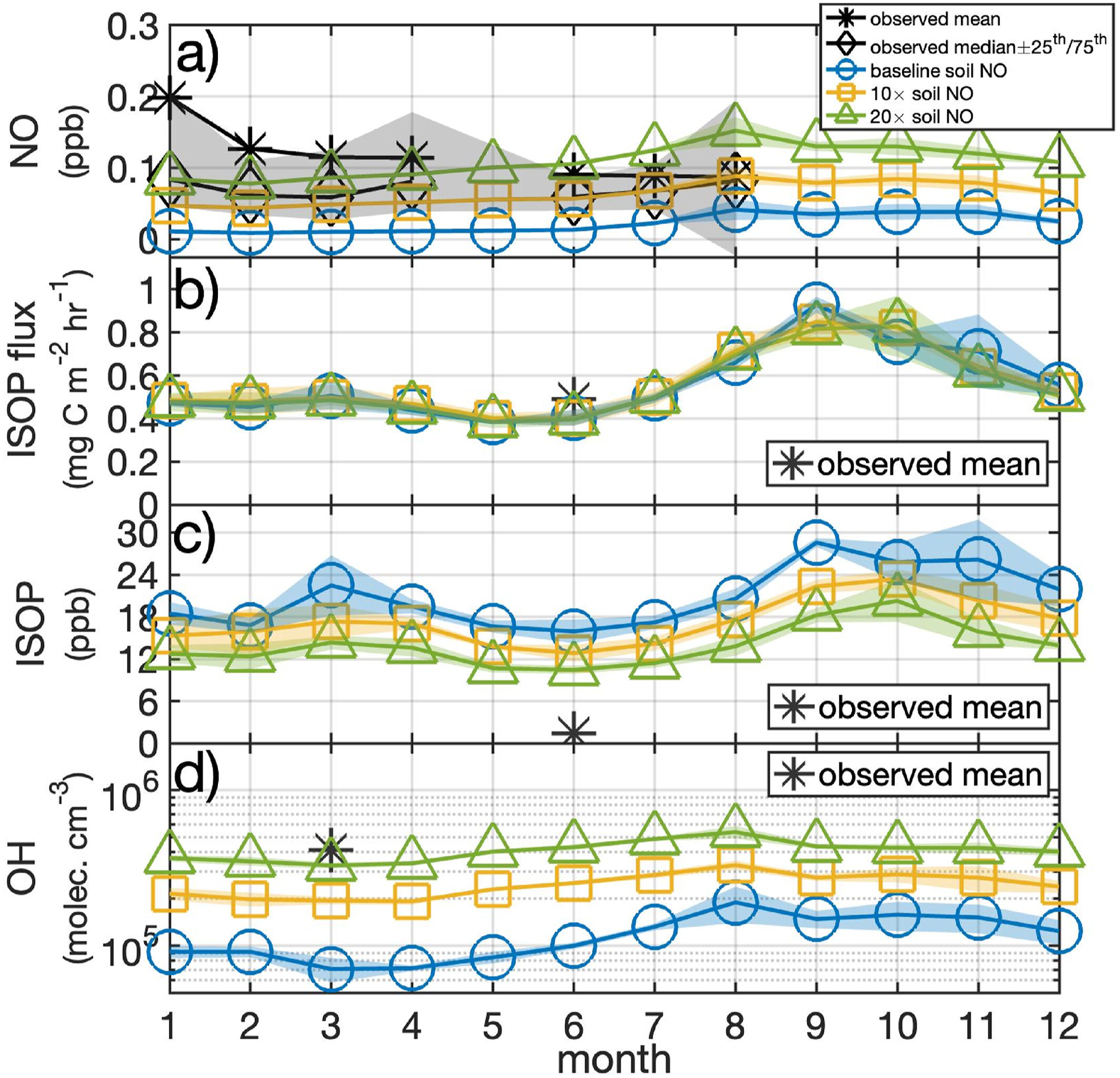
Soils are a major source of nitrogen oxides, which in the atmosphere help govern its oxidative capacity. Thus the response of soil nitric oxide (NO) emissions to forcings such as warming or forest loss has a meaningful impact on global atmospheric chemistry. We find that the soil emission rate of NO in Amazonia from a common inventory is biased low by at least an order of magnitude in comparison to tower-based observations. Accounting for this regional bias decreases the modeled global methane lifetime by 1.4%–2.6%. In comparison, a fully deforested Amazonia, representing a 37% decrease in global emissions of isoprene, decreases methane lifetime by at most 4.6%, highlighting the sensitive response of oxidation rates to changes in emissions of NO compared to those of terpenes. Our results demonstrate that improving our understanding of soil NO emissions will yield a more accurate representation of atmospheric oxidative capacity.